


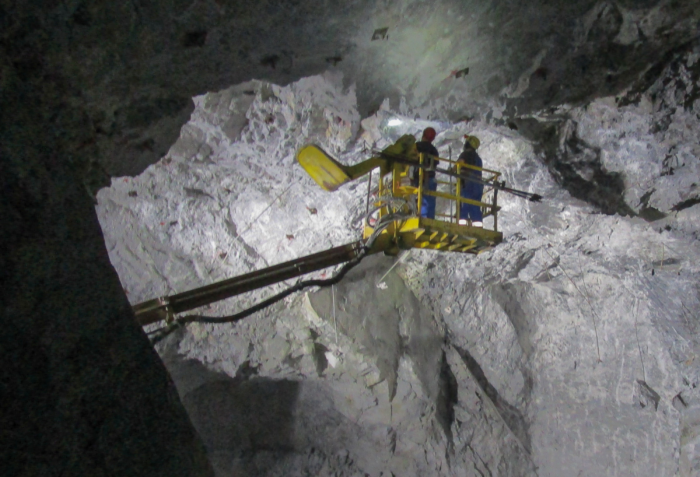
The rock mechanical assessment of underground mining structures such as drifts and tunnels is still mostly carried out manually and visually by qualified personnel. These procedures are time-consuming, prone to error, and associated with significant risks. At the same time, there is a lack of robust, networked systems that enable continuous real-time monitoring, evaluation, and response to unstable areas. The integration of digital technologies such as sensor systems, artificial intelligence (AI), autonomous robotics, and wireless communication into the complex underground environment has so far been limited.
The MineView project aims to close this gap by developing a holistic, autonomous system for rock condition assessment in underground mining. It combines multi-dimensional data acquisition (e.g. via robots, drones, and sensors embedded in rock), and AI-driven algorithms for interpretation, classification, and early warning.
Project duration: 2025 – 2028
Project partner:
On 3 June 2025, the new educational project MOSA – short for Montanuni Outdoor Science Activities – was launched. Numerous interested visitors, including pupils from the Leoben district as well as students and staff from the Montanuniversität planted 1,600 plants in carbon-enriched soil along the newly created nature trail next to the university’s research center for hydrogen and carbon.

MOSA stands for practical learning outdoors with all senses. The project brings research from the university directly to the field and demonstrates in an exciting way how resources can be used effectively. Through stations along the new nature trail, students, teachers and the interested public can interactively experience how new technologies, circular economy, biodiversity, carbon applications and renewable resources intertwine.
On the newly created area, the Montanuniversität Leoben enables active understanding of different future scenarios and thus also makes a significant contribution to the implementation of sustainable technologies.
After much fine-tuning, the first edition of MiReBooks in printed form has been printed and is now available. These books will take mining education to a higher level by incorporating VR and AR elements into teaching!
Europe needs more experts to master the complex issues of a Social License to Operate (#SLO) as currently many raw materials projects are severely delayed due to severe opposition from communities.
Coordinated by the RIC Leoben Education team, an alliance of experts on the topic of SLO from research, universities and industry designed a tailored PhD school, based around challenges provided by the industry, facilitated by innovative teaching/learning methods.
During 2025, the first edition of the course was held in a hybrid format. In February, students attended online lectures that introduced them to the basic principles and terminology of SLO from various perspectives, such as politics, society, ethics, and the environment, as well as examples of SLO. Finally, in June, the mining company Adriatic Metals invited students to spend a week on site in an active mining community in Vareš (Bosnia and Herzegovina), where they were able to interact with various stakeholders to develop a methodology for achieving SLO, supported by academic and industrial mentors.
The second edition of the PhD school is underway, split into three phases:
1. Online Phase (Virtual Week: 9 to 13 February 2026)
2. Case Study Phase (23 February to 27 March 2026)
3. Onsite School at Hellas Gold S.A. (19 to 24 June 2026, Chalkidiki, Greece)
Impressions from the first term, with images from Vareš , Bosnia-Herzegovina:


Further details under: https://www.proslo.eu/
The EMJM PROMISE aims to produce world-class mineral processing engineer postgraduates and future leaders to support the sector into a sustainable future. PROMISE is a two-year and 120 ECTS Master’s Programme.
Project Partners:
Students will have broad competence with specialisation in the main areas of mineral beneficiation emphasised in better mineral recovery from primary and secondary sources, metal recycling (urban mining), by-product recovery meeting the demands of today’s industry and environmental protection as an integral part of the circular economy.
Duration: 2022 – 2028
More information on https://www.master-promise.eu/
Apply here: https://www.master-promise.eu/how-to-apply/
Innovative Digital Sustainable Aggregates System
Duration: 06/2021 – 05/2025
The European aggregates extractive industry is, by far, the biggest non-energy extractive industries in the EU (Eurostat 2017): 26000 estimated extraction sites: 81,26% of the total EU mining and quarrying sites, 3000 million ton extracted and supplied to the EU internal market, ~ 220000 persons directly employed. Hence the EU faces the need of sustainable and competitive future for European Raw Materials specially in the construction sector due to a greater anticipated demand for products linked to human well-being, health, safety and sustainability. DIGIECOQUARRY will exploit the aggregates industry´s great potential through a coordinated approach towards construction materials management with the final goal of reducing EU external supply dependency as well as leading an efficient use of resources.
DIGIECOQUARRY will develop systems, technology and processes for integrated digitisation and automation real-time process control, to be piloted in 5 EU quarries with the target of improving health and safety conditions for workers. The pilot campaigns will lead to improved efficiency of processes maximizing quarry resources and sustainable management of water, energy emissions, minimised environmental impact and expanding the EU aggregates and construction business. Coupling Artificial Intelligence approaches with cyber-physical systems and the Internet of Things concept, make Industry 4.0 approach possible and the smart sustainable extractive site a reality. All phases of the process, from extraction to the end user are covered by DIGIECOQUARRY, ensuring communication with policy makers, social acceptance activities and international cooperation with Colombia and South Africa to share knowledge and best practices. The development of an innovative Intelligent Quarrying System (IQS) will increase the sustainable supply of minerals for the construction sector as well as enabling the sustainable extraction of EU´s mineral resources in existing and new quarries.

